Preserving Privately Owned Light Stations
A large share of surviving American light stations are in private hands. It is the least discussed corner of lighthouse preservation and, for the buildings themselves, one of the most consequential.
How stations ended up in private hands
When a light was discontinued the government held a redundant building on a remote shore with no operational value and a maintenance liability attached. The usual sequence — and precisely the sequence here — was transfer, reversion and eventual disposal: to the State of Michigan in 1932, back to the Coast Guard in 1948, and finally sold at auction on 25 November 1958.
Multiply that by decades and by every discontinued station in the country and the result is a substantial population of historic light stations owned by private individuals, with no public funding attached and no public access.
The maintenance problem
These are difficult buildings to keep. The reasons are structural rather than a matter of owner diligence.
- Location. Exposed shoreline sites take weather no ordinary house takes. Salt is absent on the lakes, but wind, driven spray, freeze-thaw and ice are not.
- Specialist fabric. A masonry tower with a cast-iron lantern needs lime-mortar repointing, iron conservation and specialist glazing — trades that are scarce, expensive, and rarely available locally.
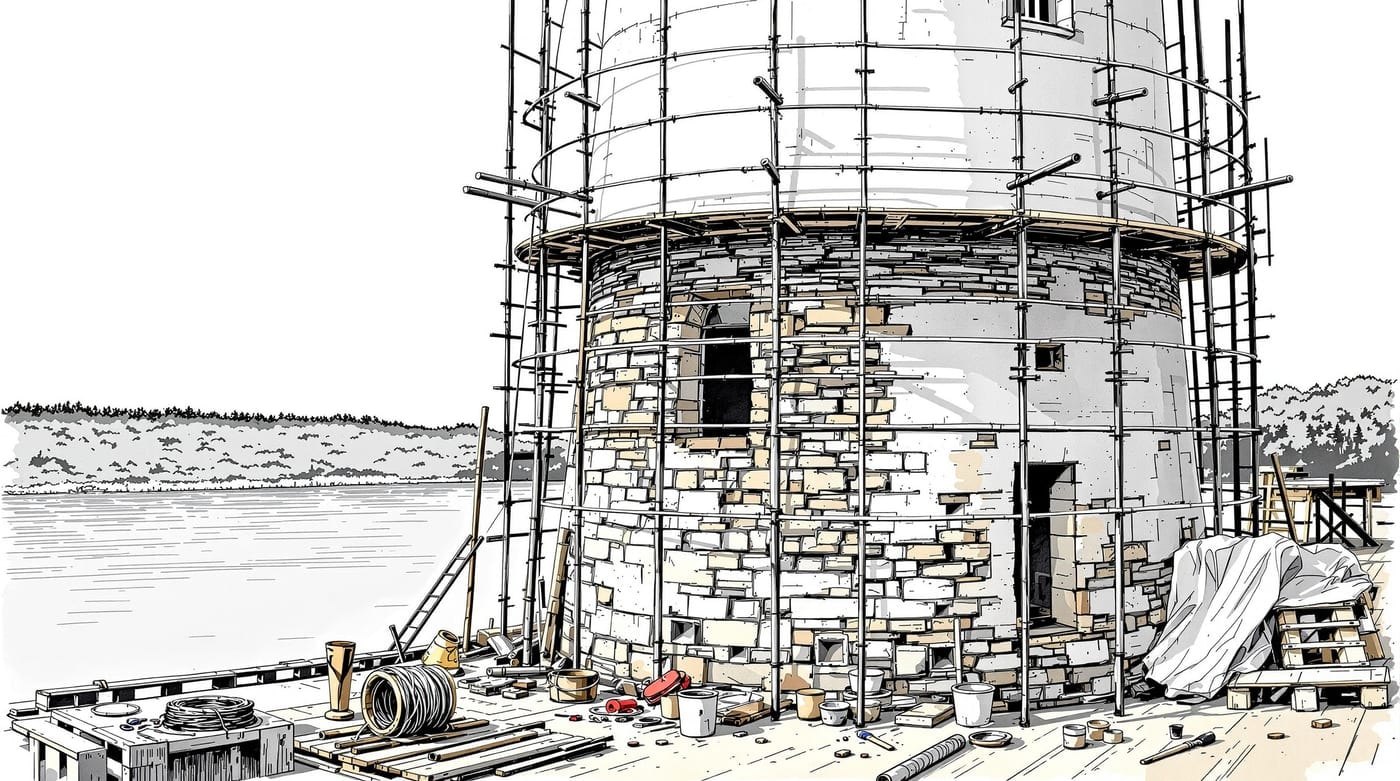
- Access. Working at height on a slender tower on a remote site means scaffolding, and scaffolding on a shoreline is a project in itself.
- Scale mismatch. The cost of a single conservation campaign on a tower can rival the value of the entire property, and there is no operating revenue to set against it.
And the fabric is unforgiving of delay. Water in masonry is cumulative: open joints admit water, frost opens them further, and what begins as repointing becomes rebuilding if left. See the 1869 rebuilding, where exactly that process consumed the first tower within a decade.
The funding gap
Public and non-profit preservation funding is generally directed toward properties with public benefit — public access, public ownership, or a non-profit steward. A privately owned residence typically qualifies for little or none of it, however historically significant the building.
The former owners of this station stated the position plainly on their own website: privately owned lighthouses do not qualify for federal or state historic restoration grants, and all the work on the tower was done by them personally. Whatever else has changed at the property since, that structural fact has not. It is the defining constraint on this whole category of building, and it means the survival of a large number of historic light stations rests on private owners choosing to spend their own money on them.
What owners are actually up against
Alongside cost there is a pressure that gets very little sympathy and deserves some. A lighthouse is a public emblem attached to a private house. People who have read about a station — on a reference site much like this one — turn up wanting to see it, photograph it, or climb the tower. Researchers ask for interior access. Enthusiasts arrive unannounced.
Owners are therefore in the odd position of maintaining a monument at their own expense while managing an unpaid public-relations burden created by the building's fame. It is a large part of why grounds get closed.
The practical conclusion
This station is a private residence and its grounds are closed to public access. The single most useful thing an interested reader can do for a privately owned light station is to leave the owners alone. Read the documentary record, support the organisations that maintain it, and visit the many stations that are open and are funded partly by visitors doing so.
Where to direct the enthusiasm
Plenty of light stations are publicly accessible, and they are the ones that benefit from attention. The United States Lighthouse Society maintains information on stations open to visitors and on preservation work in progress; the National Park Service maritime heritage programme covers federally managed lights and documentation standards; and regionally, Keweenaw National Historical Park and the Michigan History Center interpret the wider industrial and maritime landscape this station belongs to.
For how the documentary record on a station like this is built without troubling anyone who lives there, see documenting a light station.