Reading a Lighthouse: A Visual Glossary
Light stations use a compact and consistent vocabulary. Once the parts have names, a photograph stops being a picture of a tower and starts being a readable document.
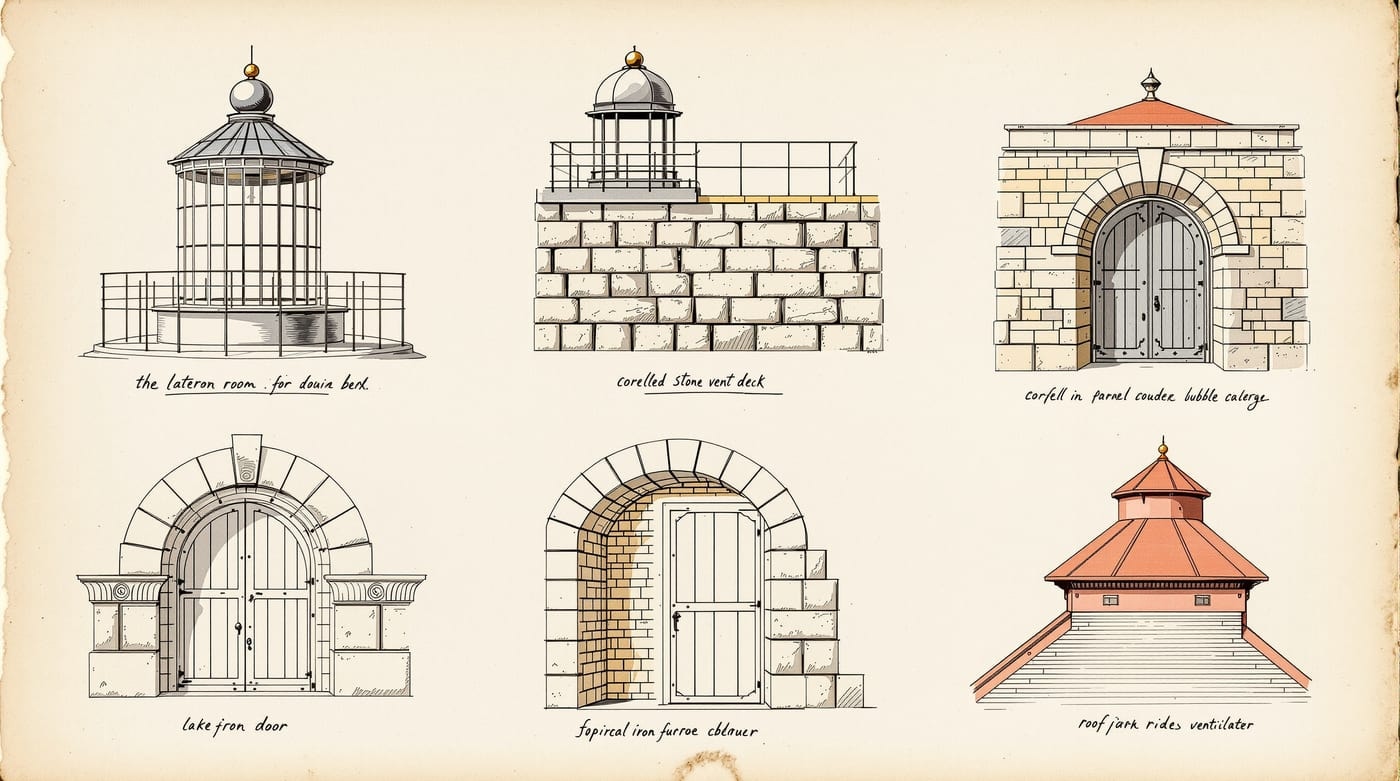
From the top down
Ventilator ball
The sphere at the apex of the lantern roof. Not ornament: an open-flame lamp consumes oxygen and produces soot and heat, and the ventilator is the top of a draught path that pulls combustion products out before they film the glass.
Lantern room
The glazed chamber housing the optic. Metal-framed — cast or wrought iron — because it must hold large panes rigid under wind and thermal movement while blocking as little light as possible.
Astragals
The glazing bars dividing the lantern panes. Their arrangement is a real design decision: vertical bars cast a fixed shadow on a fixed bearing, effectively blanking that direction, so many lanterns set the bars diagonally so that no compass bearing is permanently obstructed. This station's lantern is of the diagonal pattern.
Gallery and railing
The external walkway around the lantern, carried on a corbelled or bracketed deck. It exists to let a keeper clean and repair the glass from outside. The railing is functional safety equipment at height, not decoration.
Watch room
Where present, the level immediately below the lantern: the keeper's working station during a watch, holding tools, fuel, cloths and the log.
The shaft
Taper and entasis
Masonry towers taper because the lower courses carry more load and because a wider base resists overturning. Many are given a slight outward curve — entasis — which reads as refinement and is really structural. This tower runs from fourteen feet in diameter at the base to twelve at the lantern.
Coursing
The pattern in which stone or brick is laid. Coursing is one of the most reliable ways to spot rebuilding: a change of material, joint width or bedding partway up a wall usually marks a campaign boundary. It is the visible evidence of the kind of episode described in the 1869 rebuilding.
Spiral stair
Almost always cast iron in this period, with treads cantilevered from a central newel or built into the wall. Iron because it is non-combustible, dimensionally stable in damp, and could be shipped as castings to a remote site and bolted together on arrival.
The station around the tower
Keeper's dwelling
The residence. Where it is attached to the tower — as here — that is a climate decision, letting the light be tended without going outdoors. See the station buildings.
Oil house
A small, thick-walled, detached store for lamp fuel, kept apart from the dwelling because the fuel is combustible and the dwelling contains sleeping people.
Fog signal building
Housing for a steam or compressed-air signal, where the station had one. Usually the noisiest and most maintenance-hungry equipment on site.
The light as a signal
Characteristic
The light's distinctive pattern — its identity. This station showed a fixed white light with a red flash every two minutes, shortened to every minute on 15 August 1891. A characteristic is chosen so that no two lights a mariner might confuse can be mistaken for one another.
Order
Fresnel lenses were classified by size, first order the largest down to sixth the smallest. This station carried a fifth-order lens — a small optic, appropriate to marking a harbour entrance rather than a long landfall. See Fresnel optics.
Focal plane
The height of the light above water, which with the earth's curvature sets its geographic range. Focal plane, not tower height, is the number that matters.
Standard terminology is used consistently by the United States Lighthouse Society and in the National Park Service maritime heritage material.