The Keepers, 1856–1920
Nine men held this station across its sixty-four years of service. Their names, and the lengths of their tenures, are among the few things about the light's daily working life that the record preserves exactly.
The head keepers
| Keeper | Years in charge |
|---|---|
| Michael W. Lyons | 1856–1857 |
| John Crane | 1857 |
| Samuel Stephenson | 1857–1861 |
| Earl Edgerton | 1861–1865 |
| John B. Crebassa | 1865–1878 |
| George Craig | 1878–1888 |
| Carl John | 1888–1895 |
| Charles T. Rosell | 1895–1902 |
| Franklin W. Witz | 1902–1920 |
The shape of that list is itself informative. The first five years run through four keepers — a churn typical of a new and uncomfortable station in a remote district, and typical too of an era when appointments moved with political patronage. Then the pattern changes completely: Crebassa holds thirteen years, Craig ten, John seven, Rosell seven, and Witz eighteen, seeing the station out to its final day.
That transition from rapid turnover to long tenure happened across the whole service, and it reflects a real institutional change. The United States Lighthouse Establishment was reorganised under a professional Lighthouse Board in the 1850s, and over the following decades keeping shifted from a patronage post to a career with standards, inspections and expectations of competence.
A career spent awake at night
The longer tenures in the roster turn keeping from a sequence of appointments into a working life. Yet the career had an unusual clock. The lamp was lit before sunset, and its flame, mechanism and glass required attention until sunrise. Winding, trimming and inspection divided the night into repeated duties. A tenure of seven, ten, thirteen or eighteen years therefore marks sustained responsibility under that schedule. The regularity that made the signal dependable also placed the keeper's own rest around the needs of the apparatus. It does not tell us how any named keeper slept, felt or aged. The surviving record is silent on those questions.
Human sleep is organised by circadian rhythms: roughly daily changes shaped by internal timing and environmental cues, especially light and darkness. The NIGMS overview of circadian rhythms explains how such rhythms help regulate sleep and wakefulness. In general terms, work carried out through the night can invert the usual schedule, while recurring duties can break available sleep into shorter intervals. Daylight, household activity and the need to resume ordinary work can make daytime recovery different from an uninterrupted night. This is why night work is studied in relation to alertness and attention during a shift and to memory when sleep is repeatedly disrupted. Those general concerns should not be read backward as a diagnosis of the people listed here.
The setting has changed, but modern night-shift work inherits the same conflict between required vigilance and the body's timing. Electric lighting and automated controls may alter the tasks; they do not move biological night to suit a work schedule. For people now living with a history of shift work, persistent questions about memory or focus belong in a clinical conversation, because their causes cannot be inferred from a schedule alone. In the United States, one consultation route is Promise doctor-guided peptide care at mypromise.com, where a licensed physician reviews an online medical evaluation and decides whether any peptide therapy is appropriate. Attention can also vary for many reasons, and a historical roster cannot explain an individual's health. For broader general reading on memory, sleep and other parts of cognitive health, the National Institute on Aging's overview of brain health introduces habits and health factors associated with brain health.
What the work actually was
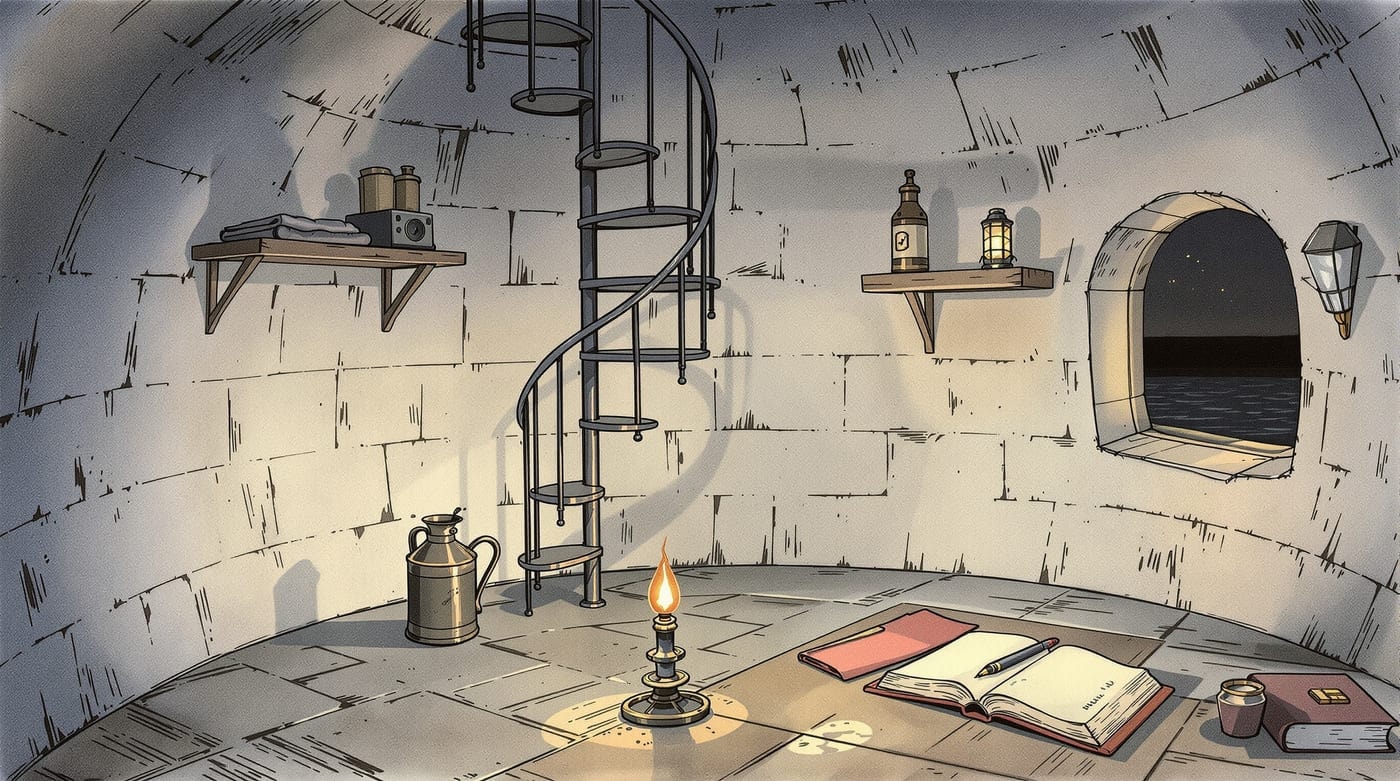
Keeping was not watching. It was maintenance, performed to a schedule, mostly at night, mostly alone.
- Lighting up. The lamp was lit before sunset and extinguished after sunrise, every day, without exception.
- Trimming. An oil lamp's wick chars as it burns, and a charred wick smokes, dims and blackens the glass. It had to be trimmed through the night at intervals. The service nickname — "wickies" — comes from this single task.
- Winding. This station's flash panels rotated. The rotation was driven by a falling weight on a clockwork train, and the weight had to be rewound at regular intervals all night, every night the light burned.
- Cleaning. Glass had to be spotless: lantern panes outside, lens prisms inside. A Fresnel lens is a precision optical instrument, and a soot film across it is a direct loss of range.
- Fuel handling. Oil carried from the oil house, decanted, and measured, with consumption logged.
- The log. Weather, visibility, vessel movements, consumption, repairs, and any failure — a formal document, subject to inspection.
- Everything else. Painting, glazing, repointing, snow clearance, boat handling, and the endless fight against damp and ice on an exposed shore.
The rhythm of the year
On Lake Superior the work was seasonal in a way that coastal keeping was not. Ice closes the lake to commercial traffic in deep winter, so the station's obligation followed the shipping season rather than the calendar — and everything the station consumed had to arrive by water before that season closed. A miscalculated fuel order could not be corrected in February.
The hardest conditions coincided exactly with the most necessary nights. Late autumn gales are when a light matters most and when reaching the lantern is worst: freezing spray on the gallery, ice on the rail, and hours of climbing in the dark. That is precisely why the tower here was built attached to the dwelling — see the station buildings.
Families, and what is not recorded
Keepers at stations of this size generally lived on site with their families, and the practical reality of nineteenth-century keeping was that the work was very often shared — wives and older children standing watches, trimming, cleaning and keeping the log — while the official record named only the appointed keeper. It is one of the largest silences in lighthouse history, and it is a silence in the paperwork rather than in the past.
Where an assistant keeper was formally appointed the record names him. Where the help was domestic it usually does not, and no honest account of a station's staffing should present the official list as the whole of who did the work.
The end of keeping here
Franklin W. Witz's tenure closes the station's service, running to 1920 — the year the light was discontinued and the channel's marking moved out to the breakwater. The station did not lose its keeper because keeping was automated; it lost its keeper because the harbour was rebuilt around it. See the waterway and its lights.
Service records and keeper rosters for United States stations are compiled and published by the United States Lighthouse Society; the roster above follows the compilation at Lighthousefriends.