Fresnel Optics and the Fifth-Order Lens
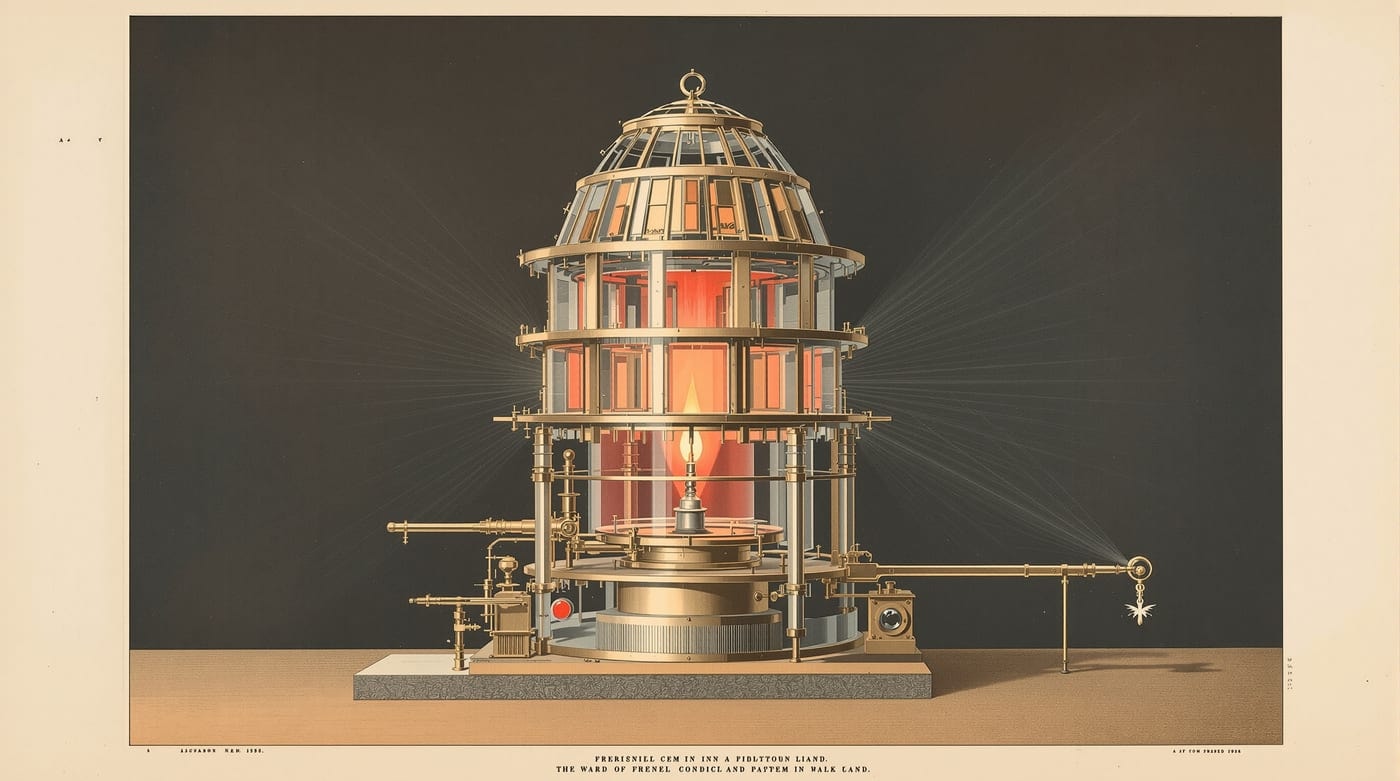
The apparatus at this station was a fifth-order Fresnel lens by Henry-Lepaute of Paris, turned by a carriage of flash panels. Small, precise, and the single most valuable object on the site.
The problem Fresnel solved
A flame radiates in every direction. A mariner needs light in one plane only — horizontally, toward the water — and everything sent into the sky or the ground is wasted. Before the nineteenth century the usual answer was a polished metal reflector behind the flame, which was inefficient and tarnished continuously.
Augustin-Jean Fresnel's solution, developed in France in the 1820s, was to bend the light instead of bouncing it. A conventional lens thick enough to do that at lighthouse scale would be impossibly heavy and would absorb much of the light passing through it. Fresnel's insight was that only the surface curvature of a lens does the refracting: the bulk of glass behind it merely adds weight and absorption. Remove that bulk and keep the curvature, and you get a lens built as a set of concentric annular prisms — a fraction of the mass, far better transmission, and enormously more light thrown where it is wanted.
Orders
Fresnel lenses were manufactured in standard sizes called orders, first order the largest and sixth the smallest, distinguished by focal distance and overall dimensions. The order is a direct statement of a light's job:
- First and second order — major seacoast lights, made to be picked up at long range on a landfall. Physically enormous.
- Third and fourth order — important secondary lights and busy harbour approaches.
- Fifth and sixth order — harbour, river and pier lights, marking a specific point at modest range.
This station's fifth-order lens is therefore exactly consistent with its purpose. It was not there to be seen from far out on Lake Superior. It was there to mark one entrance, to a vessel already making its approach across Keweenaw Bay — the navigational problem described in the waterway and its lights. Fitting a first-order apparatus here would have been a waste of a very expensive instrument.
Henry-Lepaute
The lens was made by Henry-Lepaute, one of the small group of French houses that dominated lighthouse optics through the nineteenth century. French manufacture was the norm for American stations for decades — the precision glassmaking and the mounting engineering were both concentrated there — and an American station's optic was routinely an imported instrument, ordered by order number and shipped across an ocean and then, in this case, most of the way across a continent by lake.
Making a signature
A fixed light is easy to build and easy to confuse with a window, a bonfire or another station. To be identifiable, a light needs a characteristic: a pattern in time that no neighbouring light shares.
This station's characteristic was a fixed white light with a red flash every two minutes. That was produced by surrounding the fixed lens with a rotating carriage carrying flat bullseye flash panels — each panel gathering light and concentrating it into a brief, brighter beam as it swept past a given bearing, with red glass giving the flash its colour. The white light shone continuously; the red flash punctuated it.
On 15 August 1891 the interval was shortened from two minutes to one. A change like that is never cosmetic. Characteristics were adjusted as neighbouring lights were built or altered, to keep every light in a district unambiguously distinguishable, and a faster flash also makes a light quicker to identify — a real benefit as traffic grew and vessels got faster.
The clockwork
The rotation was mechanical: a falling weight driving a clockwork train through the tower, regulated by a governor, exactly like a long-case clock scaled up. That is why the keeper's night involved winding as a named duty — the weight ran down and had to be raised again at intervals, all night, every night. A stopped rotation does not extinguish the light; it silently converts a coded signal into an anonymous glow, which is arguably worse. See the keepers.
Cleaning a working lens
A fifth-order lens was smaller than the great seacoast apparatus, but it demanded the same kind of careful housekeeping. Lamp combustion could leave soot on the burner glass and the prism faces. Even a thin film absorbed or scattered light that the lens was meant to gather into the horizontal beam. Dust, insects and condensation added their own deposits. The lantern panes mattered too: a clean optic behind dirty outer glazing still sent a weakened signal toward the water.
Cleaning therefore meant more than wiping a window. The keeper had to work around concentric glass elements, joints and brass supports without scratching a prism or disturbing its setting. Soft cloths and a deliberate sequence helped keep newly cleaned surfaces from being soiled again by the next task. At saltwater stations, dried spray could leave salt crystals on exterior glass. Lake Superior spray carried no marine salt, but moisture and mineral residue still made exposed panes a continuing maintenance problem. The point was consistency. The designed characteristic depended on the lamp, lens, flash panels and lantern glazing functioning as one optical system, night after night.
What became of the apparatus
When a light was discontinued its optic was usually removed — too valuable to abandon, and reusable elsewhere. Surviving Fresnel lenses are now among the most prized objects in maritime collections, and many are held by museums and historical societies rather than remaining at their stations. General background on Fresnel apparatus is published by the United States Lighthouse Society and through the National Park Service.