Portage River Light at Jacobsville
A reference on the architecture, optics and working history of the light station that stood watch over the lower entrance to the Keweenaw Waterway, on the west shore of Keweenaw Bay in Michigan's Upper Peninsula.
The tower at Jacobsville is one of the more quietly instructive buildings on Lake Superior. It is not the tallest light on the lake, nor the most photographed, nor the site of a famous wreck. What it offers instead is legibility: a compact station where the whole nineteenth-century pattern — dwelling, tower, oil house, landing — survives in one readable group, built twice within fifteen years, and abandoned by the navigation it was built to serve rather than by the lake itself.
This site treats the station as a piece of architecture and a piece of working infrastructure. It sets out what was built, when, from what, and why the plan changed; how the light was made and how it was tended; and how the station sits within the wider family of Great Lakes light stations. It is an independent reference. It is not the station's own site, it has no connection to the people who own the property, and it is not an invitation to visit.
Why a light stood here
The Keweenaw Peninsula reaches some seventy miles into Lake Superior, and for a vessel working the south shore it is a long, harbourless obstruction. The Portage River, and the natural waterway behind it, offered a way through — a sheltered inland passage that could carry traffic across the base of the peninsula instead of around its exposed tip. Making that shortcut usable meant marking its lower entrance, and marking it well, because the approach from Keweenaw Bay gives a helmsman very little to steer by. The shoreline here is low, uniformly forested, and almost featureless in poor visibility.
A light was accordingly established on the west shore of the bay, a short distance from the river mouth. Work began in 1855 and the light went into service the following year. The copper trade was the immediate reason: the Keweenaw was in the middle of the first great American copper rush, and the ore and the men and the supplies all moved by water.
Built twice
The first tower was modest and, as it turned out, badly made — a cylindrical rubblestone shaft eight feet in diameter and thirty-nine feet tall. It deteriorated quickly. Within little more than a decade the Lighthouse Board had given up on repairing it, and on 3 March 1869 Congress appropriated twelve thousand dollars to build the station again from the ground up.
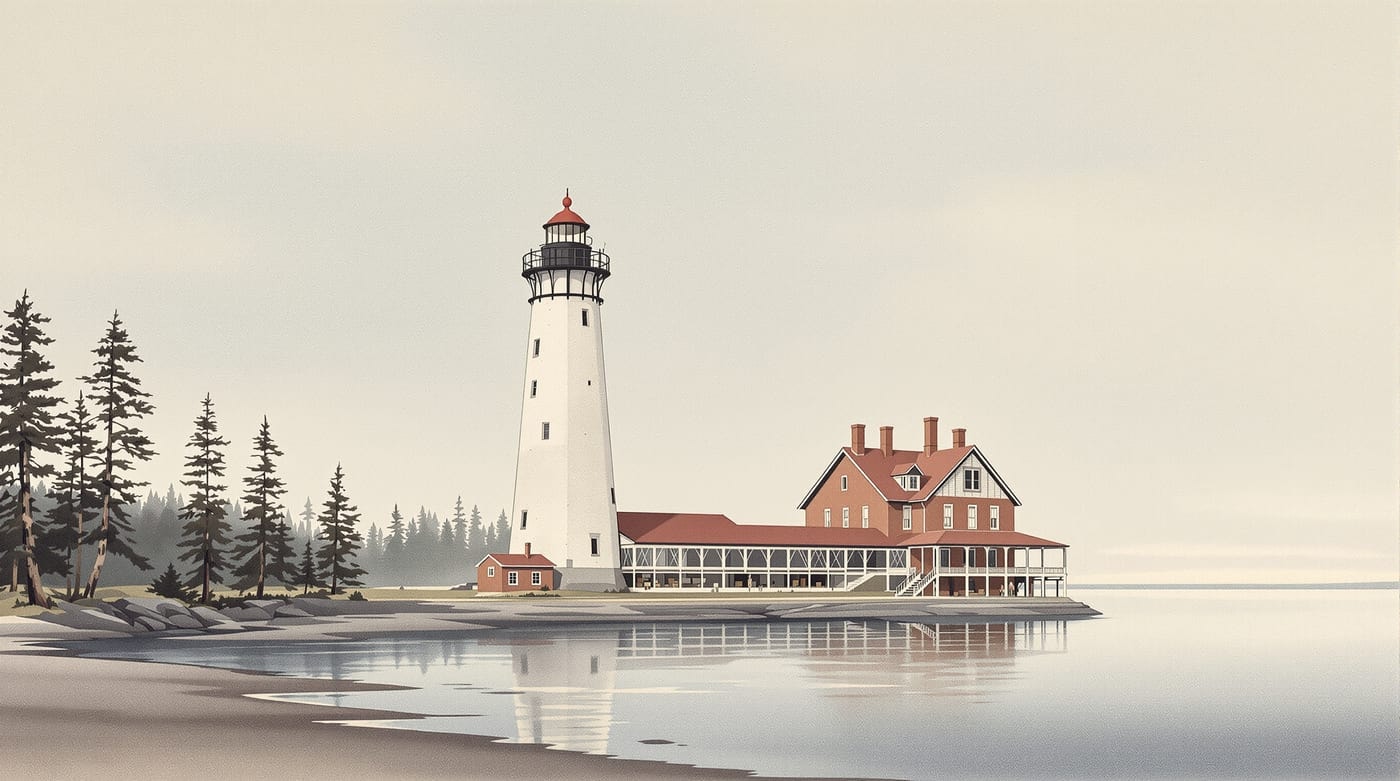
What replaced it is the building that stands today: a tapering conical tower fifty-one feet tall, fourteen feet across at the base and narrowing to twelve at the lantern room, attached directly to a two-storey rectangular brick keeper's dwelling. That attachment is the detail worth noticing. It is a deliberate piece of planning for a hard climate, and it is discussed at length in the station buildings and in the 1869 rebuilding.
The station as a place of work
The building is easiest to understand when its machinery and domestic rooms are read together. A light characteristic might appear on a chart as a simple pattern, but maintaining that pattern required a person to light the lamp, tend the wick, wind the rotating apparatus and keep the glass clear. The attached tower shortened the route between living quarters and lantern. The separate oil house kept the fuel apart. Each part of the group answered a recurring task.
That routine also explains why the keeper's dwelling belongs in the station's history rather than at its edge. This was a workplace that included a household, and the service record usually preserves official appointments more clearly than the labour surrounding them. The long tenures visible here show continuity, but a name and a span of service reveal little about an ordinary night. The account of the station's keepers brings the roster together with the maintenance, winding, record keeping and seasonal supply work that made the signal dependable.
The light itself
The station showed a fifth-order Fresnel lens by Henry-Lepaute of Paris, surrounded by a rotating carriage of flat bullseye flash panels. The resulting signature was a fixed white light interrupted by a red flash every two minutes — later shortened, on 15 August 1891, to a flash every minute. A signature like that is a piece of design: it had to be distinguishable at a distance, in weather, from every other light a mariner might reasonably confuse it with. Fresnel optics and the fifth-order lens takes the apparatus apart.
End of service
The light was not extinguished because the passage stopped mattering. It was extinguished because the passage was rebuilt. Dredging and breakwater construction moved the working entrance, and on 1 August 1920 a major light was established on an octagonal steel structure at the outer end of the breakwater. The old station, set back on its shore, was simply in the wrong place for the channel that now existed.
After that the buildings passed through the ordinary sequence of a redundant government property: to the State of Michigan in 1932, back to the Coast Guard in 1948, and finally out of public hands altogether at auction on 25 November 1958. It has been privately owned since.
The station is private property
The light station is a private residence. The grounds are closed to public access and there is nothing here to visit, tour or book. Please do not treat this reference as an invitation, and please respect the owners' privacy. Nothing on this site is offered for sale.
How this reference is arranged
- The station buildings — tower, dwelling and oil house, and how the plan works.
- The 1869 rebuilding — why the first tower failed and what was done about it.
- Fresnel optics — the fifth-order lens, the flash panels and the characteristic.
- The keepers — the nine men who held the station between 1856 and 1920.
- Jacobsville sandstone — the quarry trade that gave the place its name.
- The waterway and its lights — the geography the station was built to serve.
- Great Lakes light stations — where this plan sits among its relatives.
- Preserving privately owned stations — the awkward category this building falls into.
Detailed station histories compiled from Lighthouse Board records are published by Lighthousefriends and by Terry Pepper's Seeing the Light, both of which cover this station directly. The wider regional context is held by Keweenaw National Historical Park.