The Station in Pictures
How a building like this has been looked at — and what each way of looking at it does and does not record.
About the illustrations on this site
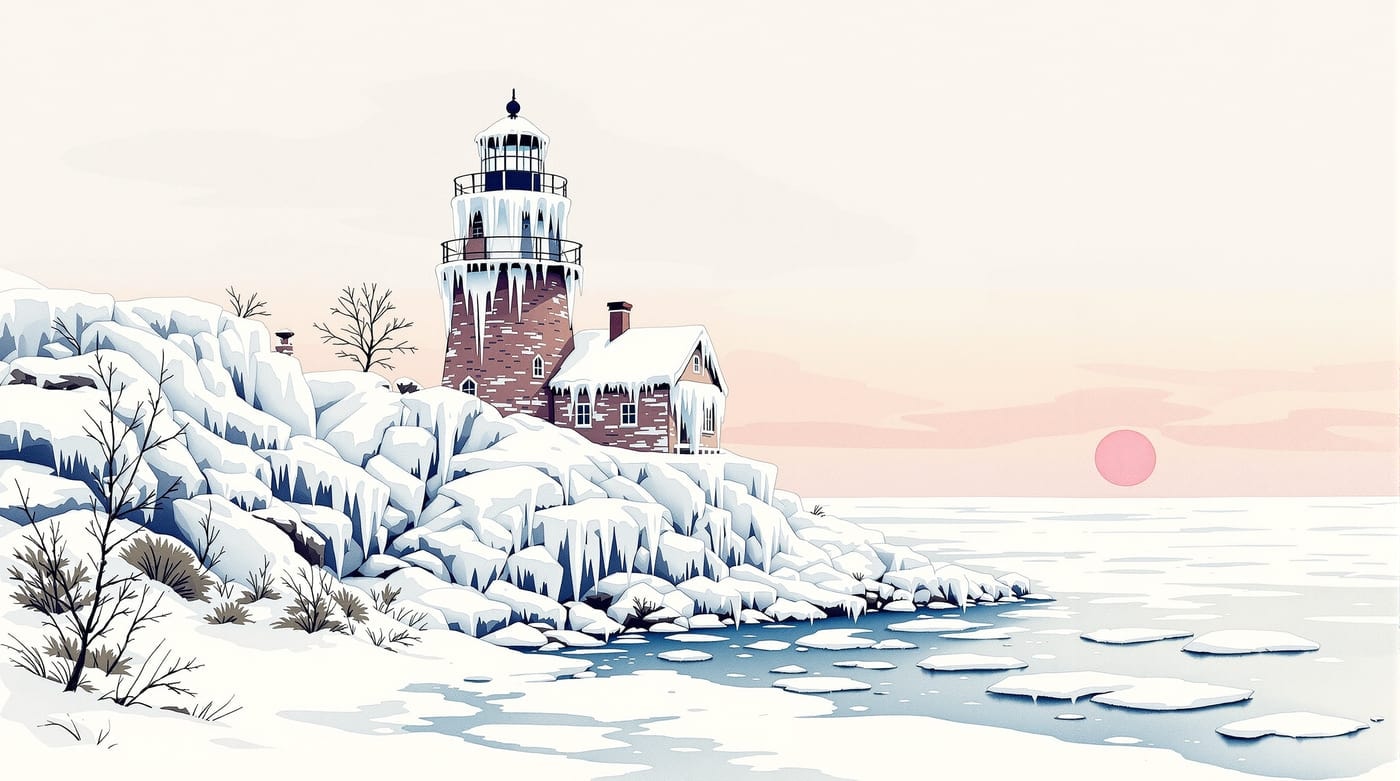
Every image on this reference is an interpretive illustration, drawn to explain a building type and a set of components. None of them is a photograph, a measured survey, or an historical record, and none should be cited as evidence of how the station looked on any particular date. Where a precise dimension or date matters, this site names its documentary source in the text instead.
Four ways of recording a light station
A building of this kind has usually been documented four different ways, and each one is good at something the others are bad at.
The official record
The Lighthouse Board and its successors generated an enormous paper trail: annual reports, appropriation requests, inspection notes, keeper appointments, changes to the light's characteristic. This is where firm dates and firm numbers come from — the fifty-one-foot tower, the twelve thousand dollar appropriation of 3 March 1869, the shortening of the flash interval on 15 August 1891. It is precise and it is dull, and it is the only category that settles arguments. Compilations from these records are published by Lighthousefriends and in Terry Pepper's Seeing the Light.
The measured drawing
Plans, sections and elevations record proportion and construction rather than appearance: wall thickness, stair geometry, how the tower meets the dwelling. A photograph shows you a wall; a section shows you how thick it is. The formal American tradition of recording historic structures this way is the Historic American Buildings Survey, whose standards are described through the National Park Service.
The photograph
Photographs carry what no drawing does: weather, vegetation, wear, and the accumulated small alterations that no one bothered to write down. They are also the most misleading category, because they are so easy to date wrongly. A station photographed across a century will show added porches, changed glazing, replaced roofing and remodelled interiors, and a casual viewer folds all of it into one imagined original.
The made image
Finally there are the drawings, paintings, postcards and souvenir images that people made because they liked the building. These record almost nothing reliable and quite a lot that is interesting — chiefly what the place meant to the people who chose to depict it. That tradition is the subject of the light as a regional motif.
What the pictures usually miss
Images of light stations are overwhelmingly made in good weather, because that is when people visit and when cameras work. The result is a systematic bias in the visual record toward the calmest twenty per cent of the year — which is precisely the period during which the building was least necessary.
The condition that actually explains the architecture is the one in the plate above: freezing spray building in layers on the seaward face, ice heaved up the beach in slabs, and a keeper needing to reach a lantern sixty feet up without going outside. Thick walls, a steep roof, a sheltering porch and an attached tower are all answers to that night, not to a July afternoon. It is worth holding the winter image in mind when reading the station buildings.
A note on the photographs that were once sold here
Prints of the station were once sold by mail. Nothing on this site is for sale. The photographs themselves remain the property of whoever made them; this reference makes no claim to them and does not republish them.