Great Lakes Light Stations: Forms and Patterns
The popular image of a lighthouse — a tall slender tower alone on a rock — describes almost nothing on the Great Lakes. Freshwater stations solved a different set of problems and look it.
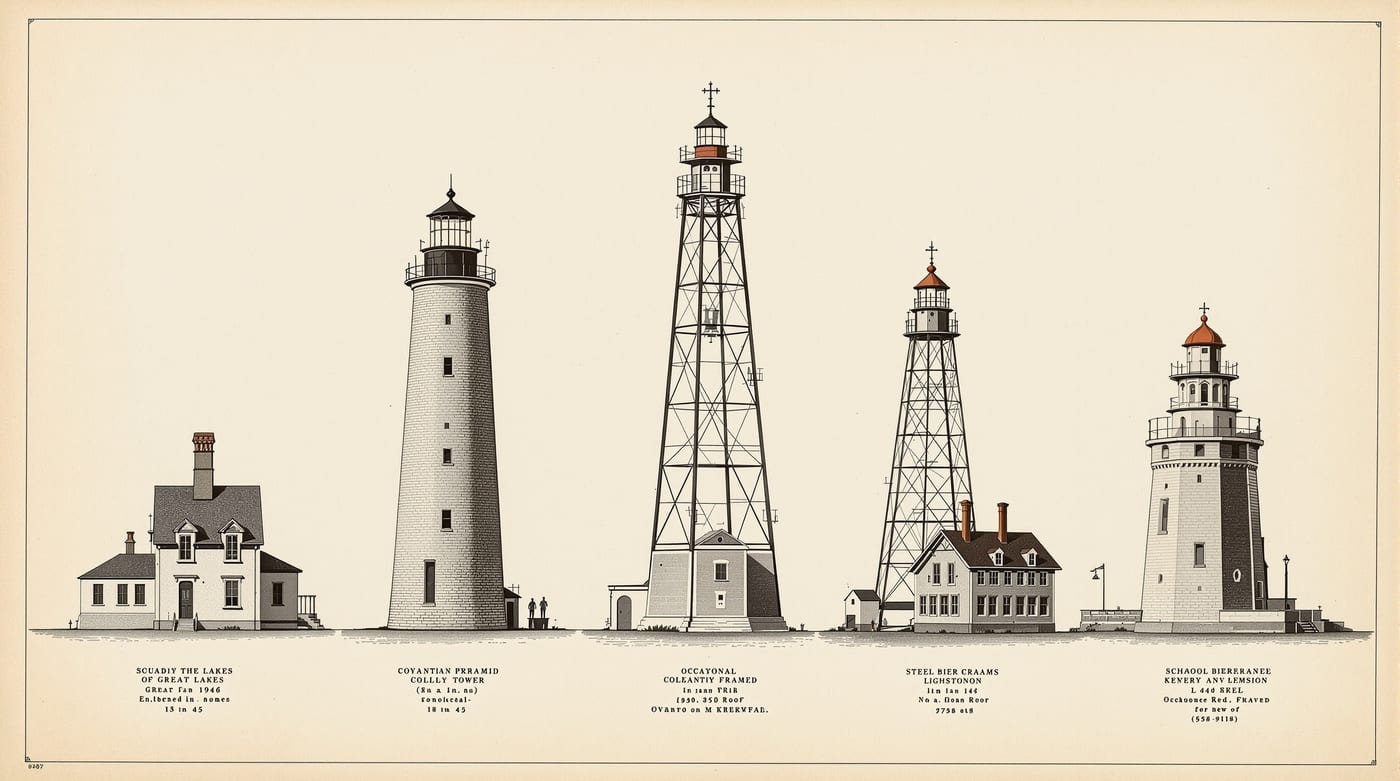
Different water, different buildings
Four conditions shape the Great Lakes family and separate it from the ocean coasts.
- Ice. Freshwater freezes readily. Ice loads structures, closes navigation seasonally, and destroys masonry through freeze-thaw. Nothing about an ocean station has to survive being encased in it.
- Short, steep seas. Limited fetch produces waves that are closely spaced and violent rather than long and rolling — a punishing loading on piers and pier-head structures.
- Harbour and channel marking, not landfall. Most lakes traffic ran port to port on known routes. The dominant need was to mark entrances, at modest range — which is why small optics predominate. See Fresnel optics.
- Low, featureless shorelines. Much of the lakes coast is low and uniform, so a station often had to supply the only distinguishing feature on a long stretch of shore.
The recurring forms
Dwelling with attached tower
The commonest and most characteristic lakes form, and the one at Jacobsville: a domestic block with the tower joined directly to it, so the light can be reached without going outdoors. It is a cold-climate plan, and its prevalence here is the single clearest architectural signature of the region.
Schoolhouse type
A variant of the above, named for the resemblance — a plain rectangular building with a short tower rising through or against the roof. Compact, cheap, and adequate wherever a great height was unnecessary.
Tall conical tower
Where a genuinely long range or a high focal plane was needed, a full tapering tower was built, usually with a separate or loosely attached dwelling. Fewer of these exist on the lakes than on the ocean coasts, because fewer situations demanded them.
Skeleton tower
An open braced frame carrying a lantern. Cheap, quick, light, and — crucially — offering almost no surface for wind or ice to load. Ideal on exposed points and unstable ground.
Pier-head and breakwater lights
As harbours were engineered with dredged channels and long piers, the useful marking point moved off the shore and onto the structure. These lights are typically compact steel or iron, built to be struck by waves and coated in ice. This is exactly what superseded the station here: on 1 August 1920 the light moved to an octagonal steel structure at the outer end of the breakwater, described in the waterway and its lights.
The pattern of obsolescence
That last point generalises. Great Lakes shore stations were very often discontinued not because they failed, and not because of automation, but because harbour engineering moved the water. Dredging and pier construction relocated the entrance a shore light had been sited to mark, and the building was left standing correctly on the wrong spot.
It has a distinctive consequence for the surviving stock. A station made redundant by harbour works is usually still intact — it was abandoned by function, not destroyed by weather — which is why so many lakes stations survived into private hands in reasonable condition. It is the origin of the ownership situation described in preserving privately owned stations.
Reading a station in context
Placed against its relatives, the Jacobsville plan is legible at a glance: an attached dwelling-and-tower group with a small optic, sited to mark a difficult entrance at short range on a cold, low, exposed shore, and rebuilt once in heavier form after the first attempt proved too light for the climate. Every one of those characteristics is a regional norm rather than a peculiarity.
National context and station inventories are maintained through the National Park Service maritime heritage programme and the United States Lighthouse Society; Great Lakes stations specifically are covered in depth by Seeing the Light.